Cellular Respiration

What Is It, Its Purpose, and More

Author: Corinne Tarantino, MPH
Editor: Alyssa Haag, MD
Editor: Emily Miao, PharmD, MD
Editor: Anna Hernández, MD
Editor: Ian Mannarino, MD, MBA
Illustrator: Jessica Reynolds, MS
Copyeditor: David G. Walker
Modified: Aug 21, 2025

What is cellular respiration?

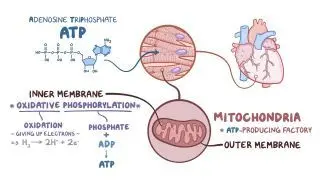
Cellular respiration is a metabolic pathway that uses glucose to produce adenosine triphosphate (ATP), an organic compound the body can use for energy. In ideal conditions, one molecule of glucose can produce a net of up to 38 ATP. However, the net yield is typically 30-32 ATP after the whole process of cellular respiration.
An infographic detailing cellular respiration.

What is the purpose of cellular respiration?

The main purpose of cellular respiration is to convert chemical energy stored in nutrients (e.g., carbohydrates, proteins, fats) to generate energy the cells can use to support many other reactions in the body. The main energy currency in cells is ATP. This molecule is particularly important for energetically unfavorable reactions that would otherwise not occur without an energy input, like muscle contraction, transport across cell membranes, protein synthesis, and cell division, among many others. 

What are the main steps of cellular respiration?

There are three main steps in cellular respiration: glycolysis; the citric acid cycle (also known as the tricarboxylic acid [TCA] cycle or the Krebs cycle); and the electron transport chain (ETC), where oxidative phosphorylation occurs. The citric acid cycle and oxidative phosphorylation require oxygen, while glycolysis can occur in anaerobic conditions.  
 
Glycolysis 
Glycolysis is a series of enzymatic reactions where glucose, a six-carbon sugar molecule, is broken down into 2 three-carbon pyruvate molecules. This process occurs in the cytosol of the cell and requires no organelles or oxygen; however, it only yields a total of 2 ATPs in the process.  
 
Once pyruvate is made, glycolysis is pretty much over. The pyruvate then moves into the mitochondrial matrix where a transition step called pyruvate oxidation (also known as pyruvate decarboxylation) takes place. In this process, a series of enzymes known as the pyruvate dehydrogenase complex converts the three-carbon pyruvate into acetyl-CoA 
 
Citric Acid Cycle 
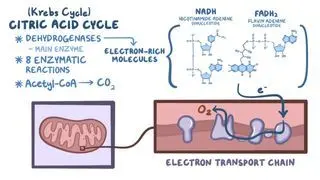
The citric acid cycle begins when acetyl-CoA combines with a four-carbon oxaloacetate to form the six-carbon citrate. Through a series of enzymatic reactions, citrate is transformed back into oxaloacetate, all the while producing energy-rich molecules like NADH, FADH₂, and ATP, which will then be used in the electron transport chain to generate the majority of ATP in cellular respiration. Because each molecule of glucose produces 2 pyruvate molecules, it takes two turns through the citric acid cycle to completely break down the original glucose, meaning the cycle’s products are doubled.  
 
Electron Transport Chain and Oxidative Phosphorylation 
The electron transport chain is the final and most energy-producing stage of cellular respiration. It occurs in the inner mitochondrial membrane and is responsible for generating the majority of ATP through a process called oxidative phosphorylation. 
 
In oxidative phosphorylation, electrons are transported across various complexes of the electron transport chain. These complexes are proteins or lipids (e.g., coenzyme Q) coupled with metals like iron and copper that facilitate the movement of electrons. The chain starts when high-energy electrons from NADH and FADH₂ produced in glycolysis and the citric acid cycle are transferred to the ETC complexes in the inner mitochondrial membrane. As electrons pass through these complexes, protons (H⁺) are pumped into the intermembrane space, creating a proton gradient, which will then be used to power ATP synthesis. An enzyme called cytochrome oxidase transfers the electrons to the final electron acceptor, oxygen, making the oxygen electronegative enough to accept two protons, making a molecule of H2O. Finally, the proton gradient that is generated causes another enzyme called ATP synthase to phosphorylate ADP, turning it into ATP.  
 
Since ATP is formed in the mitochondria, it uses an ATP/ADP shuttle to get pumped out of the mitochondria and into the cytoplasm, and that way the mitochondria gets a new ADP molecule, which is used to make the next ATP. 

Where does cellular respiration take place?

Cellular respiration takes place in the cytoplasm and mitochondria of each cell of the body. Glycolysis occurs inside the cytoplasm, while the citric acid cycle occurs inside the matrix of the mitochondria. Meanwhile, oxidative phosphorylation occurs on the inner mitochondrial membrane, with protons diffusing across and into the membrane and are later pumped back into the matrix. 

What are the reactants of cellular respiration?

The reactants of cellular respiration vary at each stage, but initially, it requires an input of glucose, ATP, and NAD+. NAD+, a nicotinamide derived from vitamin B3, is a universal electron acceptor that is crucial in the process of cellular respiration. Another important universal electron acceptor is FAD, a flavin nucleotide derived from vitamin B2. These electron acceptors are often used in catabolic processes and are reduced into NADH and FADH2respectively. 

Specifically, glycolysis requires an input of glucose, 2 ATP and 2 NAD+. Reactants for pyruvate oxidation are pyruvate, NAD+, and coenzyme A (CoA). Next, the citric acid cycle requires acetyl-CoA, 1 ADP, 3 NAD+, and 1 FAD.  

Finally, the electron transport chain through the process of oxidative phosphorylation uses the reactants ADP, NADH, FADH2, and O2. 

What are the products of cellular respiration?

The final end products of cellular respiration are ATP, CO2, and H2O. Glycolysis produces 2 pyruvate molecules, 2 ATP, 2 NADH, and 2 H2O. Therefore, without the presence of oxygen, glycolysis is the only process that can occur, and only 2 ATP molecules can be produced for each glucose molecule. Fortunately, most cells have access to oxygen, so the products of glycolysis (i.e., 2 pyruvate and 2 NADH) can be used for further energy production in subsequent steps of cellular respiration. 

When oxygen is present, pyruvate oxidation produces 1 acetyl-CoA, 1 NADH, and 1 CO2 per pyruvate molecule. The citric acid cycle then yields 1 GTP (i.e., an energy-rich compound similar to ATP used primarily in lower pH environments), 3 NADH, 1 FADH2, and 2 CO2. Of course, because a single glucose molecule produces 2 pyruvate molecules, the yield of substrates through pyruvate oxidation and the citric acid cycle is doubled. 

Finally, all of the NADH and FADH2 produced by the previous steps can be used by the electron transport chain to create further ATP as part of oxidative phosphorylation. In this step, each NADH yields approximately 2-3 ATP while each FADH2 yields 1-2 ATP. Counting up all of the end products of glucose metabolism results in a total of 10 NADH, 2 FAD, 2 GTP, and 2 ATP.  Thus, oxidative phosphorylation and the electron transport chain produce approximately 28 ATP per glucose molecule, resulting in a total of 32 ATP equivalents and a maximum theoretical yield of 38 ATP through cellular respiration.  

But, as it turns out, the NADH created in the cytosol during glycolysis must be transported into the mitochondria using a shuttle system, which results in less energy produced per cytosolic NADH. Therefore, the actual yield of cellular respiration ends up being around 30-32 ATP per glucose molecule.  

What are the rate-determining enzymes in cellular respiration?

There are three primary rate-determining enzymes in cellular respiration. These enzymes are the key regulatory enzymes that control the speed of the metabolic pathway. They act as "bottlenecks," meaning they regulate the flow of reactions and ensure energy production is adjusted to the cell's needs.  

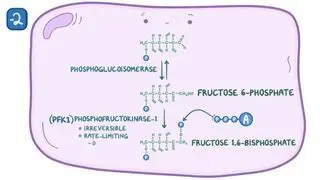
The rate determining enzyme in glycolysis is phosphofructokinase-1, or PFK-1, which converts fructose-6-phosphate to fructose-1,6-bisphosphate. PFK-1 is closely regulated by another enzyme called fructose-2,6-bisphosphate, or PFK-2. PFK-2 activity increases when blood glucose levels go up, so that more glucose can be turned into energy. At the same time PFK-1 activity is inhibited by ATP, which makes sense because cells that have lots of energy don’t need to generate even more. 

Pyruvate oxidation only uses pyruvate dehydrogenase, which is activated by increased NAD+, ADP, or Ca2+ to respond to increased demands in energy production. 

In the citric acid cycle, the rate determining enzyme is isocitrate dehydrogenase, which converts isocitrate to ɑ-ketoglutarate. The specific reaction is stimulated by ADP and inhibited by both ATP and NADH, indicating that the cell is in a high energy state.  

What diseases can affect cellular respiration?

Several diseases can affect cellular respiration. Since cellular respiration is so vital to bodily functions, many of these diseases severely affect individuals. 

 The most common diseases affecting glycolysis are pyruvate kinase deficiency, erythrocyte hexokinase deficiency, and glucose phosphate isomerase deficiency. These diseases are typically inherited in an autosomal recessive manner and individuals who are homozygous (i.e., have two affected genes) for these diseases develop hemolytic anemia, jaundice, and splenomegaly  

Deficiencies in the pyruvate dehydrogenase enzyme can interfere with pyruvate oxidation. These can result in lactic acidosis characterized by a build-up of lactate and increased serum alanine due to pyruvate build-up that then undergoes fermentation to lactic acid. Children born with these deficiencies may have neurological defects, and management of the disease typically includes keto-diets or diets high in fats which decrease the amount of glycolysis the body uses to function. 

There are several enzymes in the citric acid cycle that may be affected and result in disease, including succinyl-CoA synthase and fumarase. Many individuals with these disorders have involuntary muscle spasms and involuntary forced postures, called dystonia, and may be deaf. 

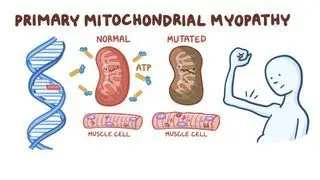
Mitochondrial myopathies are genetic disorders that affect the production of enzymes involved in the electron transport chain or oxidative phosphorylation. These diseases are classically characterized by muscle weakness and fatigue, as well as diabetes. 

Additionally, exposure to high amounts of certain drugs or toxic chemicals can affect the electron transport chain or oxidative phosphorylation. Substances that can directly inhibit complexes in the electron transport chain include carbon monoxide and cyanide. Other substances may inhibit ATP synthase, such as the antibiotic oligomycin, or disrupt the connection between the electron transport chain and ATP synthase (i.e., an electron transport chain uncoupler), such as aspirin or 2,4-dinitrophenol. Statins, which are a class of lipid-lowering medications don’t inhibit electron transport chain, but they can decrease the synthesis of coenzyme Q. That reduction in coenzyme Q can result in decreased ATP production and lead to muscle pains and cramps 

What are the most important facts to know about cellular respiration?

Cellular respiration is a series of chemical reactions that break down glucose to produce ATP, which may be used as energy to power almost all cellular reactions throughout the body. There are three main steps of cellular respiration: glycolysis, the citric acid cycle, and oxidative phosphorylation. Glycolysis takes place in the cytoplasm, the citric acid cycle occurs in the mitochondrial matrix, and oxidative phosphorylation occurs on the inner mitochondrial membrane. Under ideal conditions, cellular respiration produces approximately 36-38 ATP per each glucose molecule, but the actual net yield is closer to 30-32 ATP per glucose molecule. . The rate-determining enzymes for cellular respiration include phosphofructokinase-1 (PFK-1), pyruvate dehydrogenase, and isocitrate dehydrogenase. Disorders of cellular respiration typically disrupt one or more enzymes involved in the process, such as pyruvate kinase or succinyl-CoA-synthase, and can lead to anemia, muscle weakness, neurologic dysfunction, and a variety of other symptoms. 

Key Takeaways

Definition 

Cellular respiration is a metabolic pathway that uses glucose to produce adenosine triphosphate (ATP). 

Purpose 

- Convert chemical energy from nutrients into ATP, the main currency of the cell, used for reactions that need an energy input (e.g., muscle contraction, protein synthesis)  

Steps 

1. Glycolysis 

     - Glucose → pyruvate 

     - Pyruvate oxidation (by pyruvate dehydrogenase) → acetyl-CoA 

2. Citric acid cycle (or Krebs cycle) 

     - Acetyl-CoA + oxaloacetate → citrate → cycle regenerates oxaloacetate producing NADH, FADH₂, and ATP for electron transport chain 

     - Runs twice for each glucose molecule → products doubled  

3. Electron transport chain  

     - Oxidative phoshorylation across mitochondrial membrane 

     - Electrons from NADH and FADH₂ transported through chain complexes → protons pumped in intermembrane space → proton gradient → ATP synthase generates ATP; oxygen is final electron acceptor forming H₂O 

     - ATP is transported to the cytoplasm via an ATP/ADP shuttle 

Location 

- Glycolysis: cytoplasm  

- Citric acid cycle: mitochondrial matrix  

- Oxidative phosphorylation: inner mitochondrial membrane  

Reactants 

- Glucose 

- ATP (used in glycolysis) 

- NAD⁺ 

- FAD 

- Pyruvate (for pyruvate oxidation) 

- Coenzyme A (CoA) 

- ADP 

- O₂ 

Products 

- ATP  

- CO2 

- H2O 

Rate-determining Enzymes 

- Glycolysis: Phosphofructokinase-1 (PFK-1) 

     - Activated by PFK-2, which increases activity when blood glucose goes up 

     - Inhibited by ATP  

- Pyruvate oxygenation: pyruvate dehydrogenase  

- Citric acid cycle: isocitrate dehydrogenase  

Diseases Affecting Cellular Respiration 

- Glycolysis:  

     - Pyruvate kinase deficiency  

     - Erythrocyte hexokinase deficiency 

     - Glucose phosphate isomerase deficiency 

     - Pyruvate dehydrogenase deficiency  

- Citric acid cycle:  

     - Succinyl-CoA synthase deficiency  

     - Fumarase deficiency  

- Electron transport chain:  

     - Mitochondrial myopathies  

     - Exposure to carbon monoxide 

     - Exposure to cyanide  

     - Drugs: oligomycin, aspirin, statins, 2,4-dinitrophenol 

References


Baynes JW, Dominiczak MH, eds. Medical Biochemistry. 6th ed. Elsevier - Health Sciences Division; 2022. 


El-Gharbawy A, Koeberl D. Glycolysis. In: Inborn Errors of Metabolism. Oxford University Press; 2014:119-133. 


Kierans SJ, Taylor CT. Glycolysis: A multifaceted metabolic pathway and signaling hub. J Biol Chem. 2024;300(11):107906. doi:10.1016/j.jbc.2024.107906 


Martínez-Reyes I, Chandel NS. Mitochondrial TCA cycle metabolites control physiology and disease. Nat Commun. 2020;11(1):102. doi:10.1038/s41467-019-13668-3 


Nolfi-Donegan D, Braganza A, Shiva S. Mitochondrial electron transport chain: Oxidative phosphorylation, oxidant production, and methods of measurement. Redox Biol. 2020;37(101674):101674. doi:10.1016/j.redox.2020.101674 


Rocha H. Inborn glycolytic pathway defects. In: GlycolysisElsevier; 2024:321-332. 


Russell OM, Gorman GS, Lightowlers RN, Turnbull DM. Mitochondrial diseases: Hope for the future. Cell. 2020;181(1):168-188. doi:10.1016/j.cell.2020.02.051 


Zhao RZ, Jiang S, Zhang L, Yu ZB. Mitochondrial electron transport chain, ROS generation and uncoupling (Review). Int J Mol Med. 2019;44(1):3-15. doi:10.3892/ijmm.2019.4188