Homozygous Otospondylomegaepiphyseal Dysplasia (OSMED)

What Is It, Signs & Symptoms, and More

Author: Lahav Constantini MD
Editor: Alyssa Haag, MD
Editor: Ian Mannarino, MD
Editor: Kelsey LaFayette, DNP, ARNP, FNP-C
Illustrator: Jessica Reynolds, MS
Copyeditor: David Walker
Modified: Nov 23, 2025

What is homozygous OSMED?

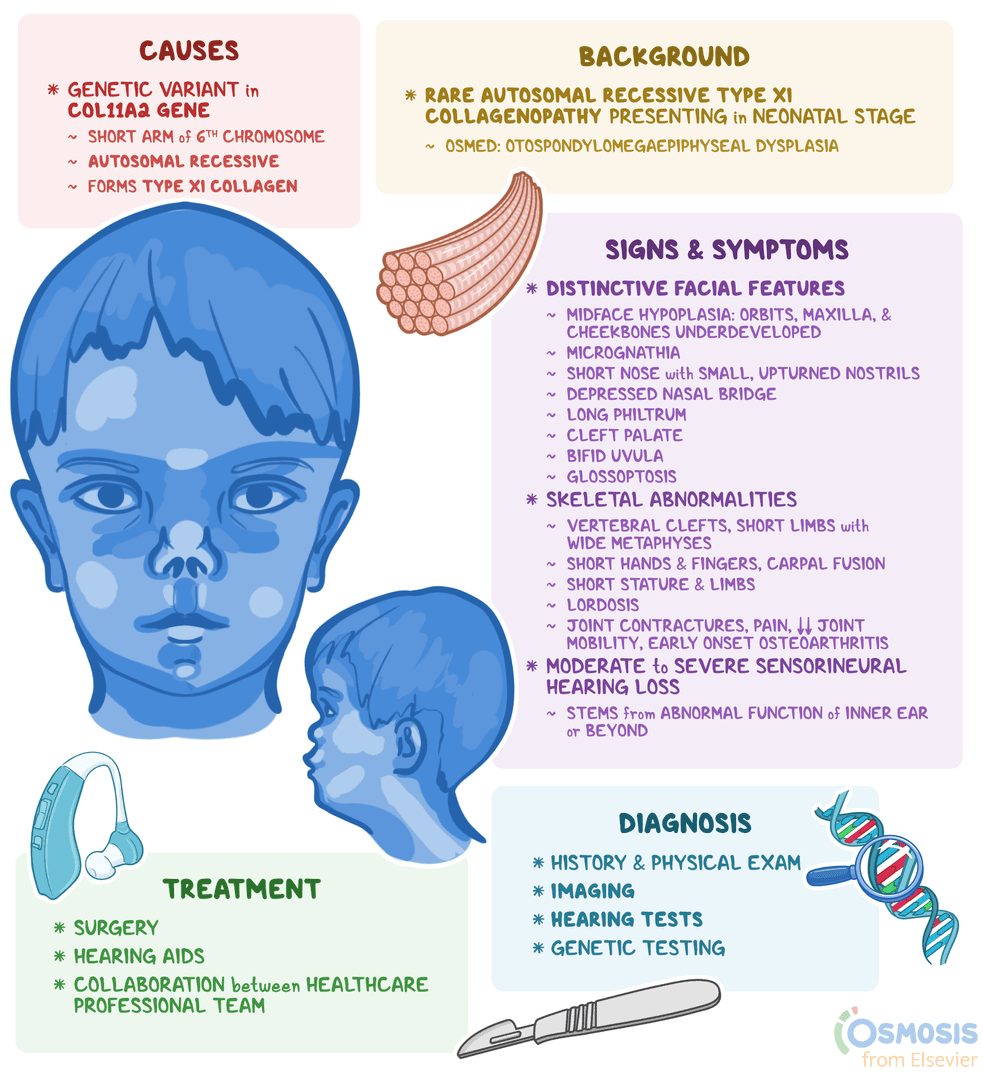
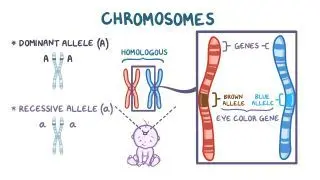
Homozygous otospondylomegaepiphyseal dysplasia (OSMED) is an extremely rare genetic disorder characterized by dysplasia (i.e. cell abnormalities) and deformities in certain parts of the body. “OSMED” refers to the most typical parts of the body that are affected by the disorder. “Oto” refers to the ears, “spondylo” meaning spine, and “megaepiphyseal” referring to the ends of long bones. Affected individuals have distinctive facial featuressensorineural hearing loss, and skeletal malformations in the spine and long bones, resulting in a short stature and joint-related problems (such as pain, restricted mobility, and osteoarthritis). “Homozygous” refers to the pattern of inheritance of the disorder, which is autosomal recessive (i.e. two mutated alleles are necessary to cause the disease). 
An infographic detailing homozygous otospondylomegaepiphyseal dysplasia (OSMED).

What causes homozygous OSMED?

Homozygous OSMED is caused by a genetic variant in the COL11A2 gene, on the short arm of the sixth chromosome, which is responsible for formation of type XI collagenType XI collagen has important functions in the body, including formation of several connective tissues (such as cartilage) and production of collagen fibrils that help make up the extracellular matrix. Once mutated, shorter α2 chains are produced, which are less likely to be integrated into the collagen molecules.  

Homozygous OSMED occurs when both alleles of the gene are mutated; or in other words, it is inherited as an autosomal recessive trait, meaning that one mutated allele is inherited from each parent. Conversely, there are heterozygous OSMED disorders that are inherited as an autosomal dominant trait, meaning that only one allele needs to be inherited from one parent to cause the genetic condition. Heterozygous OSMED includes both Weissenbacher-Zweymuller syndrome and Stickler syndrome type III, also known as nonocular Stickler syndromeSome researchers consider these disorders as distinct entities, while others consider them as a spectrum of conditions with a clinical overlap. Nonetheless, all these syndromes are considered type XI collagenopathies, given that they all affect collagen production.  


What are the signs and symptoms of homozygous OSMED?

Newborns with homozygous OSMED can have multiple distinctive facial features. Typically, these include midface hypoplasia, in which the orbits, maxilla, and cheekbones are underdeveloped compared to the rest of the face, giving a flat appearance; hypertelorism (i.e. increased distance between the orbits); micrognathia (i.e. small mandible); a short nose with small and upturned nostrils; depressed nasal bridge; long philtrum (i.e. the groove between nose and upper lip); cleft palate; bifid uvula; or glossoptosis (i.e. retraction of the tongue). 

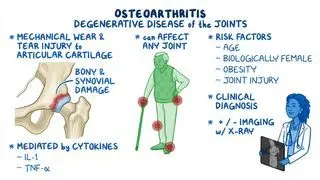
Affected individuals may have skeletal abnormalities, including spinal deformities (e.g. vertebral clefts); short limbs and wide metaphyses, especially in the ankle, resulting in dumbbell-shaped limbs; short hands with short fingers; and possible fusion of the carpal bones. As the individuals grow, the disproportionate short stature and short limbs as well as an exaggerated anterior-posterior curvature of the spine (i.e. lordosis) become more evident. Additionally, several joint problems may start to appear, including joint contractures and pain; reduced joint mobility; or even early onset of osteoarthritis, which is the degeneration of cartilage 

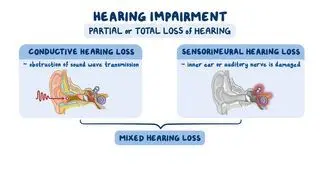
Lastly, homozygous OSMED is often characterized by moderate to severe sensorineural hearing loss, or hearing impairment that stems from abnormal function of the inner ear or beyond (in particular, the cochlea or the neural pathway of auditory transduction). Intelligence, on the other hand, typically remains unaffected.   

How is homozygous OSMED diagnosed?

Diagnosis of homozygous OSMED is based on a thorough clinical examination that includes complete medical history, physical examination, and additional tests, including imaging to determine presence of the distinctive clinical features of the disorder. Hearing tests as well as X-rays are particularly important for evaluating the presence of hearing loss and typical skeletal abnormalities (e.g. shortening of long bones, large epiphyses, specific vertebral anomalies), respectively. Genetic testing to identify variants in the COL11A2 gene may also be performed.

How is homozygous OSMED treated?

Management of homozygous OSMED includes supportive and symptomatic treatment. It may include surgery for closure of the cleft palate or correction of other skeletal deformities and joint problems, like joint replacement. There’s also monitoring and management of the hearing loss (e.g. with hearing aids). 

The management of an individual with this syndrome typically warrants collaboration between several medical professionals from various disciplines, including pediatricians, otolaryngologists, and orthopedic surgeons to construct an optimal treatment plan and ensure the best possible care. 

What are the most important facts to know about homozygous OSMED?

Homozygous otospondylomegaepiphyseal dysplasia (OSMED) is an exceedingly rare autosomal recessive type XI collagenopathy that typically presents in the neonatal stage. It is caused by a biallelic genetic variant in the COL11A2 gene. The syndrome is characterized by distinctive facial features, joint problems, sensorineural hearing loss, and characteristic skeletal deformities (including spinal abnormalities and shortening of long bones), resulting in a disproportionate short stature. Diagnosis of the disorder is based on evaluating the individual’s clinical features and may also involve audiometry, X-ray, and genetic testing. Treatment is multidisciplinary and symptomatic, mainly aimed at correcting the skeletal abnormalities and managing the hearing loss and joint pain.  

References


Harel T, Rabinowitz R, Hendler N, et al. COL11A2 mutation associated with autosomal recessive Weissenbacher-Zweymuller syndrome: molecular and clinical overlap with otospondylomegaepiphyseal dysplasia (OSMED). Am J Med Genet A. 2004;132(1):33-35. https://doi.org/10.1002/ajmg.a.30371


Otospondylomegaepiphyseal dysplasia. Genetic and Rare Diseases Information Center. Published April 13, 2023. Accessed April 13, 2023. https://rarediseases.info.nih.gov/diseases/4130/osmed-syndrome


Otospondylomegaepiphyseal dysplasia. Orphanet. Published April 13, 2023. Accessed April 13, 2023. https://www.orpha.net/consor/cgi-bin/OC_Exp.php?lng=en&Expert=1427


Otospondylomegaepiphyseal dysplasia, autosomal dominant; osmeda. Online Mendelian Inheritance in Man (OMIM). Accessed November 22, 2025. https://www.omim.org/entry/184840?search=col11a2&highlight=col11a2


Stickler syndrome, type II; STL2. Online Mendelian Inheritance in Man (OMIM). Accessed November 22, 2025. https://www.omim.org/entry/604841


Temtamy SA, Männikkö M, Abdel-Salam GMH, et al. Oto-spondylo-megaepiphyseal dysplasia (OSMED): clinical and radiological findings in sibs homozygous for premature stop codon mutation in the COL11A2 gene. Am J Med Genet A. 2006;140(11):1189-1195. https://doi.org/10.1002/ajmg.a.31205