Case study - Atrial fibrillation (Afib): Nursing
Introduction0:00–0:55
Nurse Derek works on an inpatient cardiac unit and is caring for Mrs. Alvarez, a 76-year-old female with a history of hypertension, who was admitted with new-onset atrial fibrillation, or a-fib, with rapid ventricular rate, or RVR.
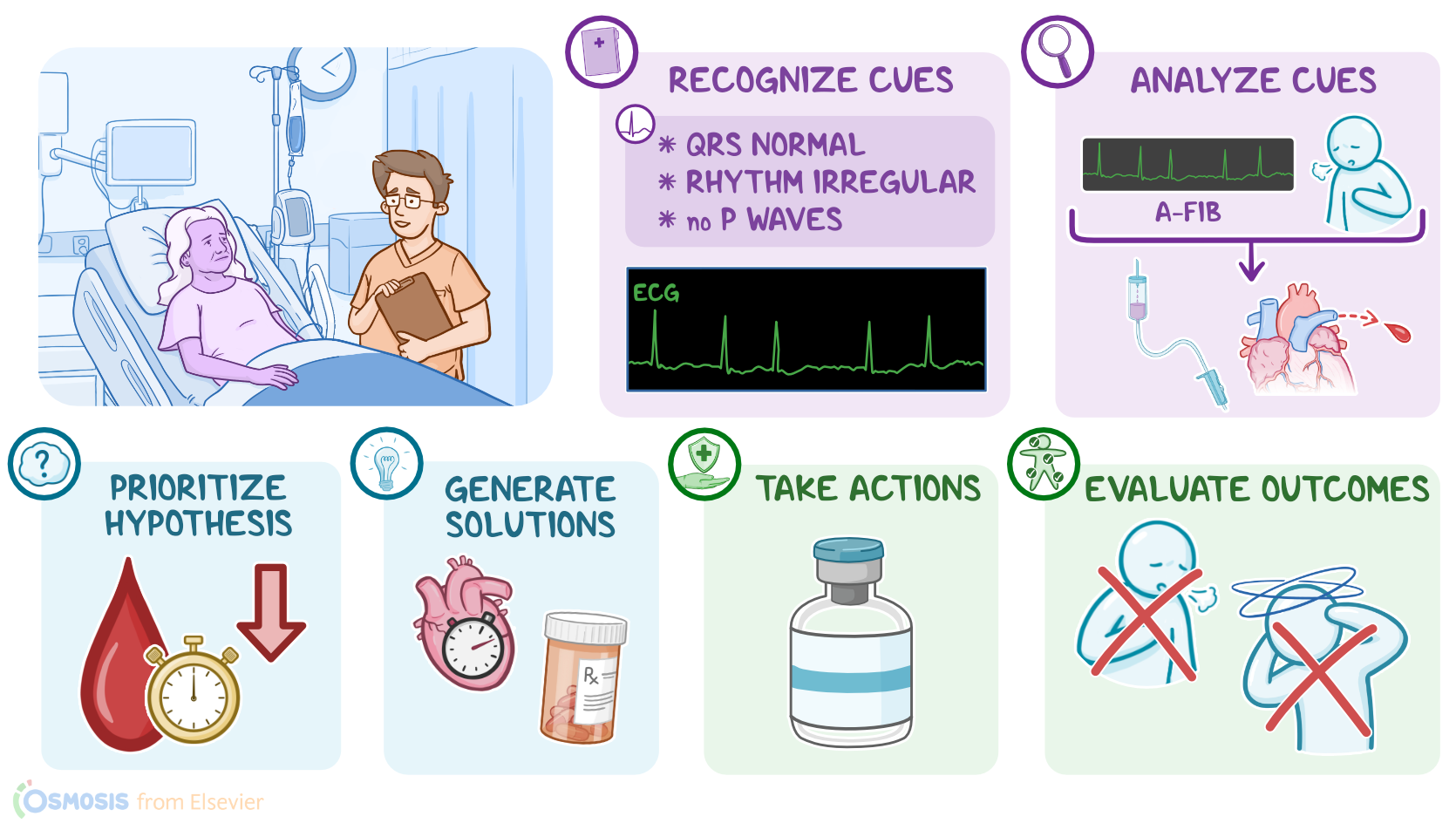
Alvarez in the room, Nurse Derek goes through the steps of the Clinical Judgment Measurement Model to make clinical decisions about her care by recognizing and analyzing cues, prioritizing hypotheses, generating solutions, taking action, and evaluating outcomes.
First, Nurse Derek recognizes important cues, including Mrs. Alvarez’s vital signs, which are blood pressure 100/74 mmHg, heart rate 112 beats per minute, and respirations 22 breaths per minute.
Recognizing and Analyzing Cues0:55–2:27
After placing Mrs. Alvarez on continuous cardiac monitoring, he evaluates her ECG, noting the QRS complexes are normal, but the rhythm is irregular and there are no P waves.
She denies pain but reports mild shortness of breath, diaphoresis, and feeling dizzy and tired with movement. Next, Nurse Derek analyzes these cues.
He determines that Mrs. Alvarez is still in a-fib.
He then reviews the electronic health record, or EHR, and notes that her diltiazem drip is ordered to be titrated as needed to maintain a heart rate of less than 100 beats per minute; and the drip was last titrated in the emergency department one hour ago.
Nurse Derek also realizes that rapid and irregular atrial contractions can lead to decreased cardiac output and tissue perfusion, causing Mrs.
Alvarez’s symptoms, therefore, she needs more effective heart rate control. Now, using the information he's gathered, Nurse Derek chooses a priority hypothesis of decreased cardiac output.
Prioritizing Hypotheses, Generating Solutions, and Taking Action2:27–5:06
Then, he generates solutions to promote heart rate control that will include pharmacologic interventions. He establishes the expected outcome that after intervening, Mrs.
Alvarez will maintain a heart rate of less than 100 beats per minute within two hours. Nurse Derek then takes action to implement these solutions.
He knows that the diltiazem drip was adjusted one hour ago in the emergency department, so he can titrate it again since Mrs.
Alvarez’s heart rate remains above 100 beats per minute. However, he has only cared for one other patient on a diltiazem drip and is concerned about his inexperience with the medication, so he calls the charge nurse to help him titrate the drip.
Once the charge nurse arrives at the bedside, they review the medication order together. Charge Nurse: Hi Derek, how can I help you?
Nurse Derek: Thank you for coming, could you verify my titration of Mrs. Alvarez’s drip?
Charge Nurse: I sure can! Mrs.
Alvarez: Is everything alright? I’m not sure what’s going on.
Nurse Derek: Your heart is beating faster than normal and it’s in an irregular rhythm which is why you’re feeling short of breath.
Your health care provider prescribed a medication called diltiazem to slow your heart rate, but we need to adjust the dose since your heart rate is still elevated.
The charge nurse is here to verify the medication adjustment to help bring your heart rate back to normal. Mrs.
Alvarez: Okay, I see. How will you know the medicine is working?
Nurse Derek: I’m going to continuously monitor your heart rate and rhythm and assess your vital signs while adjusting the medication.
The goal is for your heart rate to be less than 100 beats per minute. Mrs.
Alvarez: How long do I have to stay on this drip? Nurse Derek: Once your heart rate stays less than 100 beats per minute, I’ll notify the health care provider to determine the next steps for long-term heart rate and rhythm control.
Mrs. Alvarez: Okay, thank you.
Nurse Derek and the charge nurse adjust the diltiazem drip rate on the IV pump using safe medication administration principles.
Nurse Derek then instructs Mrs. Alvarez to use the call bell to alert him if she has new or worsening symptoms.
Evaluating Outcomes5:06–6:02
Thirty minutes later, Nurse Derek re-enters the room to evaluate the outcome of his actions. He assesses Mrs.
Alvarez’s vital signs and her cardiac rhythm. Her blood pressure is 118/80 mmHg, heart rate 90 beats per minute, and respirations 18 breaths per minute.
When asked about her symptoms, Mrs. Alverez reports that her shortness of breath has improved, and she doesn’t feel dizzy.
Her heart rhythm remains in a-fib, but the rate is now controlled. Mrs.
Alvarez appears comfortable, but she reports that she's anxious about whether her heart rhythm will go back to normal. Nurse Derek recognizes that Mrs.
Alvarez’s heart rate goal has been met, and he’ll revise the plan of care to address her anxiety. He plans to stay at the bedside to discuss Mrs.
Alvarez’s concerns and answer additional questions. Alright, as a quick recap....
Review6:02–6:35
Nurse Derek recognized and analyzed cues related to Mrs. Alvarez’s a-fib with RVR and prioritized hypotheses and generated solutions to address this problem.
Nurse Derek then implemented pharmacologic measures to maintain her heart rate within the expected range and evaluated Mrs.
Alvarez’s outcomes compared with the expected outcome. Since Mrs.
Alvarez had concerns about treatment, Nurse Derek will revise the plan of care to address
| CASE STUDY - ATRIAL FIBRILLATION (AFIB) | ||
| KEY POINTS | NOTES | |
| INTRODUCTION |
| |
| RECOGNIZING AND ANALYZING CUES |
| |
| PRIORITIZING HYPOTHESES, GENERATING SOLUTIONS, AND TAKING ACTION |
| |
| EVALUATING OUTCOMES |
| |
- " Lewis's medical-surgical nursing: Assessment and management of clinical problems. (12th ed.). " Elsevier. (2022)
- "Medical-surgical nursing: Concepts for interprofessional and collaborative care. (10th ed.). ISBN: 978-0323654050 " Elsevier. (2021)
- "Lewis’s medical-surgical nursing in Canada: Assessment and management of clinical problems. (5th ed.). ISBN 978-0323791588 " Elsevier. (2023)
No notes for this video yet
Try adding a note below